Study facts at a glance
Fixed formulation: TRI-LUMA contains topical hydroquinone 4%, tretinoin 0.05% and fluocinolone acetonide 0.01%. These identify the product, not a mixing instruction. Source 1
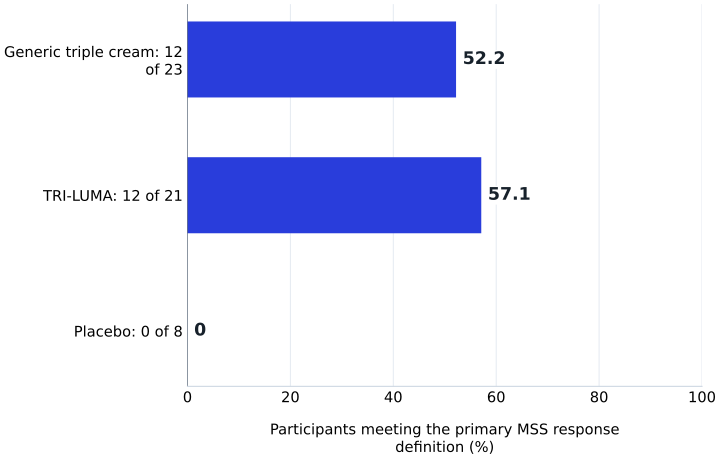
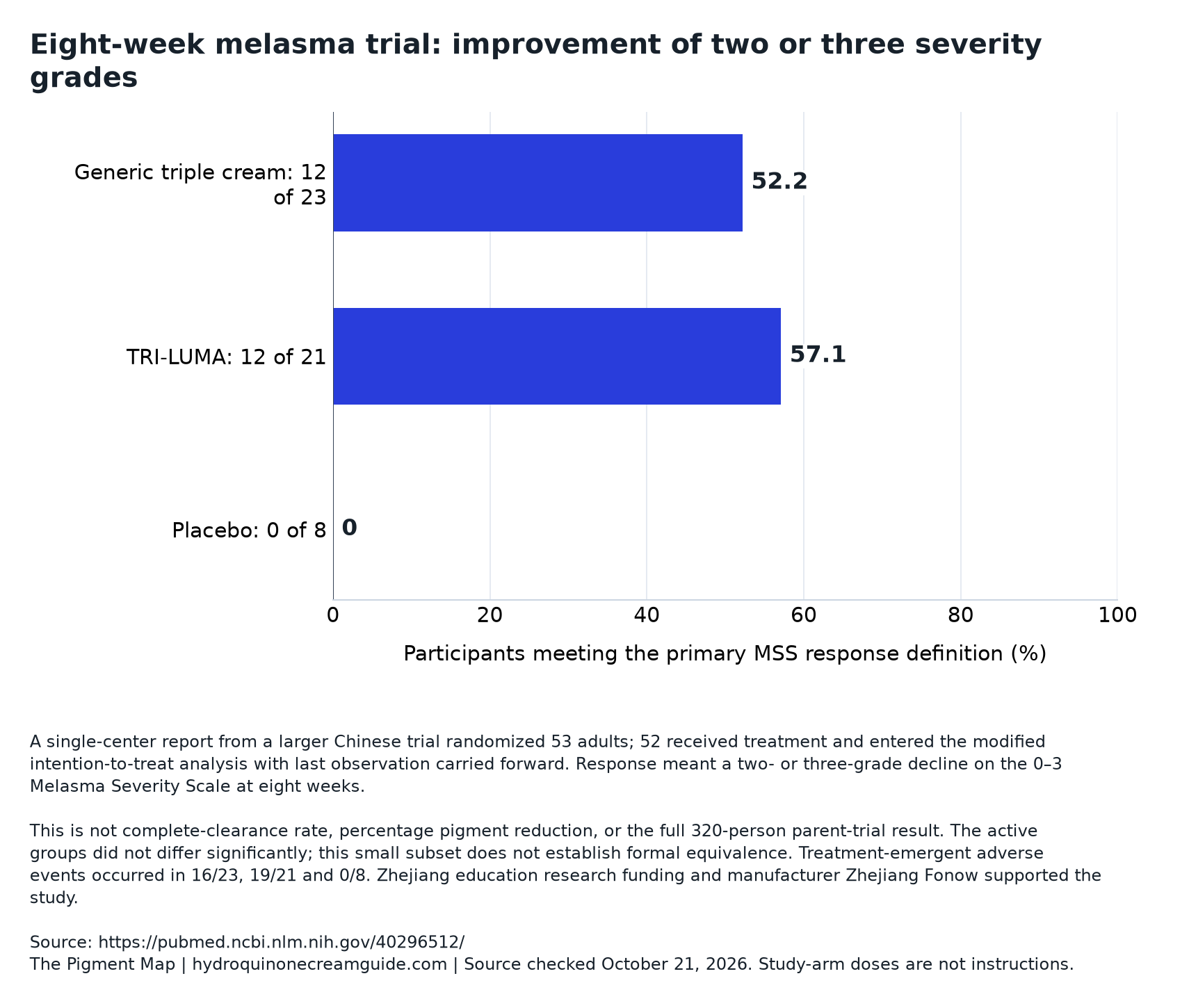
Primary Chinese endpoint: Response meant an eight-week decline of two or three grades on the 0–3 Melasma Severity Scale (MSS). Source 3
Ingredient identity: Fluocinolone acetonide is the corticosteroid component. Source 1
Conditional contribution: Removing one ingredient can investigate its contribution alongside the ingredients that remain. It does not measure the removed ingredient alone. Source 1
Attribution boundary: A difference between complete products does not, by itself, identify the ingredient or biological process responsible. Source 3 Source 1
Treat the formulation as the unit being tested
An ingredient list answers what a cream contains. A clinical comparison answers what happened under specified treatment conditions. Moving between those descriptions requires more information than recognizing one ingredient name. A concentration describes composition; a response rate describes outcomes among people. They have different denominators, different units and different roles in an argument about effectiveness.
Consider an illustrative label containing ingredient A at one concentration and ingredient B at another. The larger percentage does not tell us which ingredient contributes more to a clinical result. Comparing the printed numbers would confuse the amount present with the effect being measured. Nor does counting three active ingredients establish that the total effect is three times the effect of one. That relationship would need evidence, not arithmetic applied to a label.
The guide to strengths and combination creams helps organize the identity questions before evaluating an outcome. For interpretation here, the most useful description is a complete treatment specification: named actives, concentrations, dosage form and the conditions under which the formulation was assessed. This is a method for identifying relevant evidence, not a recipe for reproducing a prescription or a claim that differently described products are necessarily inferior.
Read the underlying chart data: download CSV or download the source-labeled chart.
Identify what the Chinese comparison changed
This randomized, double-blind Chinese single-center subset assigned 53 participants to generic cream, TRI-LUMA or placebo (24/21/8); most were women with epidermal melasma, aged 33–55.
With complete formulations as the alternatives, the treatment assignment changes more than a single named ingredient. A comparison with placebo can evaluate the overall treatment package against that comparator. Comparing two active formulations asks how their outcomes differ under the study conditions. Neither contrast isolates hydroquinone from the retinoid and corticosteroid when those actives travel together. Attribution must follow the assignment that was actually made.
Imagine testing two three-part combinations against a reference preparation. Even if one combination produces a larger measured change, the result alone cannot identify which part explains the difference. The explanation might remain unresolved after the outcome comparison is complete. Asking a narrower ingredient question requires a design that changes the relevant component while preserving an interpretable background. The melasma-versus-dark-spots assessment guide adds another boundary: the condition being assessed is part of the evidence match, just as the formulation is. The research question must remain specific.
Use omitted-component comparisons carefully
The US label describes two eight-week trials totaling 641 participants, comparing TRI-LUMA with each dual-active combination in the same vehicle. Success required MSS zero.
These comparisons ask about a component in the presence of particular partners. The table keeps the separate trial outcomes beside each formulation. An ingredient omitted from a pair is not being tested against nothing; it is being evaluated against the background of the two ingredients that remain. Consequently, its contribution in that setting need not equal its contribution in a different combination or when used alone. Those are separate empirical questions, even when the same ingredient name appears throughout.
A clinically useful contrast therefore has a precise grammatical form: the complete formulation compared with this specified alternative, for this outcome. It does not produce a universal score for each molecule. The prescription guide can help distinguish a documented formulation from a broad ingredient description. Before attaching a component-level conclusion to another prescription, a reader would need to determine whether the comparison being invoked actually addresses that formulation and background. The presence of one shared active is only a starting clue.
Separate US label trials: MSS zero at eight weeks. Each cell retains its own denominator.
| Treatment | Trial 1 cleared | Trial 2 cleared |
|---|---|---|
| TRI-LUMA: all three actives | 32/85 (38%) | 10/76 (13%) |
| Hydroquinone + tretinoin | 12/83 (15%) | 3/75 (4%) |
| Fluocinolone acetonide + tretinoin | 0/85 (0%) | 3/76 (4%) |
| Fluocinolone acetonide + hydroquinone | 3/85 (4%) | 1/76 (1%) |
Keep clinical contribution separate from mechanism
A clinical difference after removing a component would show that the treatment assignments mattered for the selected outcome. It would not, on its own, reveal the biological path connecting the ingredient to that outcome. The label states that the combination’s mechanism in melasma is unknown. An appealing explanation of ingredient roles should not be mistaken for a mechanism demonstrated by the outcome trial.
For illustration, suppose a full combination improves a score more than a pair. That difference is compatible with several questions still being open: whether the extra component has a direct effect on the measured condition, whether it changes another component’s contribution, or whether it affects participants’ experience of treatment. These are possibilities to investigate, not explanations established for these creams. Assigning a preferred mechanism requires measurements or comparisons that discriminate among the possibilities.
The same reasoning applies to claims of synergy, meaning that a combination performs beyond a specified expectation from its components. Such a claim needs an explicit reference model and the component comparisons needed to evaluate it. Showing that a complete treatment exceeds one pair does not automatically establish every interaction among its ingredients. A clear clinical result can be valuable while the explanation for that result remains incomplete.
Preserve the event counted in the result
The Chinese analysis excluded one untreated participant and used last observations for missing scores: 52 were analyzed, while 44 completed (18/19/7 by arm). The table separates its primary response from treatment-emergent adverse events.
The two columns count different events. A person may meet a response criterion and also report an adverse experience; the categories are not mutually exclusive. Subtracting one percentage from the other would not produce a valid net benefit score. Such a score would require explicit judgments about which benefits and harms matter, their severity and how they should be combined. Those judgments cannot be supplied by the shared percentage sign.
The response criterion also concerns a change in grade, not the amount of pigment removed. On an ordered scale, a movement of several categories does not imply a matching fraction of a biological quantity. Nor does meeting a change criterion necessarily specify the same final state for everyone. This helps explain why an endpoint based on improvement should not be treated as interchangeable with the label’s clearing endpoint. Differences in the rule can change who counts as a success before any treatment comparison is considered.
Chinese trial at eight weeks: MSS response meant a two- or three-grade decrease; adverse-event counts are participants, not total events.
| Treatment | MSS responders | Treatment-emergent adverse events |
|---|---|---|
| Generic combination | 12/23 (52.2%) | 16/23 (69.6%) |
| TRI-LUMA | 12/21 (57.1%) | 19/21 (90.5%) |
| Placebo | 0/8 (0%) | 0/8 (0%) |
Do not turn an uncertain difference into interchangeability
The Chinese active-arm efficacy comparison was nonsignificant and did not establish formal equivalence. That distinction concerns the question asked of the data, not merely the wording of a conclusion.
A conventional difference test asks whether the observations provide sufficient evidence against a specified no-difference hypothesis. An equivalence analysis instead needs boundaries defining a difference small enough for its purpose, together with enough precision to evaluate those boundaries. An imprecise result might fail to establish a difference while still allowing differences large enough to matter. Without the necessary interval and criterion, a nonsignificant result cannot complete the equivalence argument.
There are also different meanings of sameness to keep apart: a matching ingredient list, a matching concentration, a matching clinical endpoint and a sufficiently similar clinical effect are separate propositions. Evidence for one does not automatically establish the others. As an editorial application, the CoreAge Rx hydroquinone review is a place to examine documentary terms. It is not evidence that the service supplies either trial formulation or reproduces the study outcome. A service comparison should begin with what is documented, then identify which scientific evidence actually matches that description.
Ask a specific safety question about the corticosteroid
Irritation, but not overall adverse-event incidence, differed significantly (12/23 versus 17/21). One TRI-LUMA recipient withdrew with exfoliation; no atrophy or telangiectasia was observed during eight weeks.
Those findings do not isolate the corticosteroid’s effect on tolerability, because the two active assignments both include that component. Attributing an irritation difference to its presence would require a contrast in which its presence actually differs. Even then, a safety conclusion would need the relevant event definitions and observation period, rather than borrowing the design of an efficacy comparison as proof of a safety mechanism.
The label warns about systemic corticosteroid effects, including adrenal suppression, as well as sulfite hypersensitivity, ochronosis and local reactions. These concerns belong to different categories of harm. A short study’s absence of a particular finding cannot settle risk over longer exposure or in people with different circumstances. The irritation-and-allergy guide helps frame what a reaction needs assessed. A scientific account should distinguish frequency, severity, persistence and effect on participation; compressing them into a single statement that a product is safe would discard information needed for an individual clinical discussion.
Treat the surrounding care as part of the experiment
The cream trial supplied cleanser, moisturizer and sunscreen to every group. A separate five-month randomized study of 42 women compared tinted with untinted sunscreen; 41 completed. Clinical mMASI improved in both groups without a significant between-group difference, while the primary measurements assessed color.
A shared background makes the assigned treatment contrast easier to interpret within that background. It does not independently measure the benefit of every supporting element. Likewise, a sunscreen comparison does not determine whether a prescription cream could be omitted from a different care plan. Connecting treatments into a routine is a clinical decision; demonstrating the effects of that combined routine would require an experiment addressing the combination.
The sunscreen study analysis examines why color measurements and clinical severity need separate readings. The sun-protection guide provides related practical context. For scientific interpretation, the useful question is whether the comparison changes the cream, the surrounding care or both. If several elements change together, an observed outcome belongs to the combined assignment. Separating their contributions would require additional comparisons, even if each element already has a plausible individual rationale.
Match the scientific claim to the product’s documented status
TRI-LUMA’s label concerns short-term facial melasma treatment, not maintenance; phototypes V–VI and other hyperpigmentation conditions were not studied. FDA separately warns that no OTC skin-lightening products are FDA-approved or legally marketed, and reports rashes, swelling and potentially permanent ochronosis with hydroquinone lighteners.
These sources answer different questions. The label identifies the boundaries of an approved prescription product. The notice addresses a regulatory category and reported harms. Neither determines the status of every preparation advertised with similar ingredient language. A named compounded product requires its own documentation; a trial result cannot supply missing facts about what that product contains or how it is provided.
Our editorial interpretation is to compare records in sequence: identify the condition, identify the actual formulation, distinguish the product’s status and then examine the clinical comparison relevant to it. The Dermatica hydroquinone review can help locate formula and subscription terms for scrutiny without implying that its service was studied here. A concentration printed prominently in an offer should not displace the rest of that documentary work. Nor can a regulator’s report of harm establish an incidence rate or prove that a particular untested provider product caused it.
Make the next ingredient question testable
Zhejiang’s education research fund and Fonow supported the cream trial; Fonow supplied products, and authors declared no conflicts. NAOS funded the sunscreen study; three authors were current or former employees, with industry honoraria also disclosed.
Disclosures help readers assess the research context, but the comparison structure still determines what can be inferred. To investigate a proposed component benefit, a future study would need to specify the background treatment, the component being varied and the outcome expected to change. If the claim concerns tolerability, it should measure that outcome directly. If it concerns a clinical response, the response definition should be fixed before interpreting the results.
A particularly useful design would explain which differences are clinically meaningful and provide estimates precise enough to assess them. It would also account for incomplete observations and document reasons for withdrawal, so the analysis does not quietly select only those who tolerate the treatment. These are proposed features of an informative experiment, not claims that a new combination has already passed one. The best next ingredient question is narrow enough to be answered by the assigned comparison, leaving other questions explicitly open rather than allowing the familiarity of an ingredient to fill the gaps.
Questions about the evidence
Does evidence for a combination also prove hydroquinone alone works the same way?
No. The treatment being compared includes its full set of ingredients and the surrounding conditions. To assign the same result to one ingredient alone, the evidence would need a comparison that actually tests that proposition. A combination result can motivate a narrower research question, but cannot supply the missing answer simply because hydroquinone appears in the formulation.
Why is leaving one ingredient out more informative than comparing percentages on labels?
An omitted-component comparison can change one specified element against a defined background and then measure an outcome. Label percentages describe quantities rather than outcomes. The resulting evidence is still conditional on the partners and conditions used; it does not create a universal numerical value for that ingredient across all products or conditions.
Can lower irritation identify which component made a cream easier to tolerate?
Not without a comparison that separates the proposed explanation. If the relevant component is present in both treatments, its mere presence cannot explain their difference. A component-specific tolerability claim needs appropriate assignments and direct safety measurements. It also needs attention to the kind and severity of events, since different adverse experiences should not be treated as equivalent.
Does a favorable sunscreen result establish the best complete melasma routine?
It informs the sunscreen comparison that was studied. Selecting a complete routine introduces additional questions about the other treatments, their combination and the person being assessed. Evidence from separate experiments can guide those questions, but joining their conclusions does not produce an experimental test of the combined routine or identify which element is responsible for its outcome.
What should a provider comparison document before borrowing a trial result?
It should identify the actual formulation and distinguish it from a broad ingredient category. Then the condition, comparator and measured outcome need to match the scientific claim being made. Subscription terms and follow-up arrangements require their own records. A treatment trial does not verify those service details, just as a service description cannot establish a clinical effect.
What this evidence supports
The most defensible reading starts with the treatment contrast. A whole-cream comparison can support a conclusion about whole creams under the studied conditions. A comparison omitting one active can narrow the question to that component’s contribution alongside its partners. Neither automatically identifies the mechanism, proves interchangeability with another preparation or resolves all safety questions. For The Pigment Map, the practical value of this distinction is a clearer chain of reasoning: establish the formulation, identify what changed between groups, preserve the endpoint and keep uncertainty visible. The corticosteroid component deserves an explicit place in that chain because an efficacy result and a tolerability explanation require different evidence. A careful comparison can therefore recognize a measured benefit while leaving the ingredient-level explanation and the decision for a particular person to the evidence and clinical assessment they require.
Research access and limitations
This analysis uses the full Chinese trial, the official US prescribing information, the sunscreen research letter with its verified funding footnote and the current FDA notice. The sunscreen supporting-information document and numerical values inferred from figures were not reviewed. No conclusion about a compounded product’s equivalence, US availability of the studied generic, individual treatment duration or comparative cost is established here.