Study facts at a glance
Design: 42 women randomized; 21 per group. Source 4
Window: Five months in southern France during summer. Source 4
Primary endpoint: Instrumental colorimetry. Source 4
Completion: 41 completed; one pregnancy withdrawal; final arm counts unreported. Source 4
Funder: NAOS Ecobiology Company. Source 4
A proposed ingredient role is a question to test
Mechanistic reasoning and clinical evidence do different jobs. A proposed mechanism can explain why a component might be relevant and guide the selection of measurements. A clinical experiment observes what happens under defined conditions. Agreement between a plausible explanation and a favorable observation can be informative, but it does not automatically identify which part of a preparation caused the change.
Imagine a hypothetical cream containing components A and B. If people improve after using it, that observation does not allocate a fraction of the improvement to each component. The preparation could involve several relevant properties, and the comparison could include other aspects of care. Distinguishing those contributions requires an experiment designed around that question rather than a retrospective division of the overall result.
Our editorial interpretation is to read the whole combination formula before discussing ingredient-specific evidence. The practical question is what was actually compared: one complete preparation, the addition of a component to a fixed background, or the component by itself. Those are different experimental questions. A familiar ingredient name can help locate the relevant record, but it cannot replace the comparison needed to support a causal claim about that ingredient.
Read the underlying chart data: download CSV or download the source-labeled chart.
Similar protection characteristics help define the comparator
Bioderma Photoderm M SPF50+ Golden (pVL 66) was compared with an untinted formula offering similar UV protection. Here pVL means visible-light protection factor. Its pigments included iron oxides and pigmentary titanium dioxide. The scientific value of the comparator lies in the question it makes possible. When preparations share relevant characteristics, investigators can ask about a more focused difference than a comparison with no product would address.
However, matching selected test characteristics is not the same as proving the preparations identical in every other respect. A complete formulation includes more than a single named ingredient. To isolate a component rigorously, the design would need to specify which features are held constant and what is deliberately changed. Without that structure, the observed contrast belongs to the tested preparations as a whole.
A protection factor is also a different type of evidence from a clinical response. It describes a measured property under a particular test framework. It is not a percentage of patients helped or a prediction of an individual outcome. The guide to sun protection in a broader pigment plan discusses the care context. Here, the narrower research task is to keep the tested property attached to its definition before connecting it to changes observed in people.
Random assignment does not separate a formula into its parts
Investigators were blinded; participants aged 28–58 had phototypes III–IV. A masked assessment can reduce the influence of knowing which product was assigned. It addresses how an observation is evaluated, while random allocation addresses how the groups are formed. Neither design feature, on its own, separates the effects of ingredients that were administered together.
That distinction is easy to overlook when a study is described simply as randomized. Randomization supports a specified comparison; the identity of that comparison still matters. If the assigned interventions are complete products, the resulting treatment contrast concerns those products. An assertion about one component requires another step of reasoning, and that step should be stated rather than hidden inside the study’s design label.
The population boundary remains equally relevant. A result observed in a defined group does not answer every question about another age group, skin type or condition. Our guide to assessing melasma and other dark spots explains why naming the concern comes first. The scientific interpretation can then ask whether the experiment applies to that concern, rather than using a shared appearance to carry ingredient claims across diagnoses without supporting evidence.
An instrumental change needs an explicit clinical meaning
Color contrast improved significantly within the tinted arm, but not within the untinted arm. A contrast measurement compares areas; it does not directly identify the cause of a change in either area. Our interpretation therefore asks what the measurement represents before using it as evidence for an ingredient’s clinical benefit.
Consider a purely methodological example involving two measured regions. Their difference might narrow because one changes, because both change by unequal amounts or because the reference region changes. The difference alone does not distinguish those possibilities. This example is not an account of unreported participant results. It explains why the component measurements and the conditions of assessment remain important even when a derived contrast is measured precisely.
A clinical meaning must then be established separately. An instrumental change might be detectable without proving that the condition has cleared or that people experience a meaningful improvement. The follow-up photography guide addresses another way of documenting change, with its own requirements for comparability. Each method can contribute information, but none should acquire the meaning of another merely because all are used to discuss the appearance of pigmentation.
Keep clinical evidence separate from component attribution
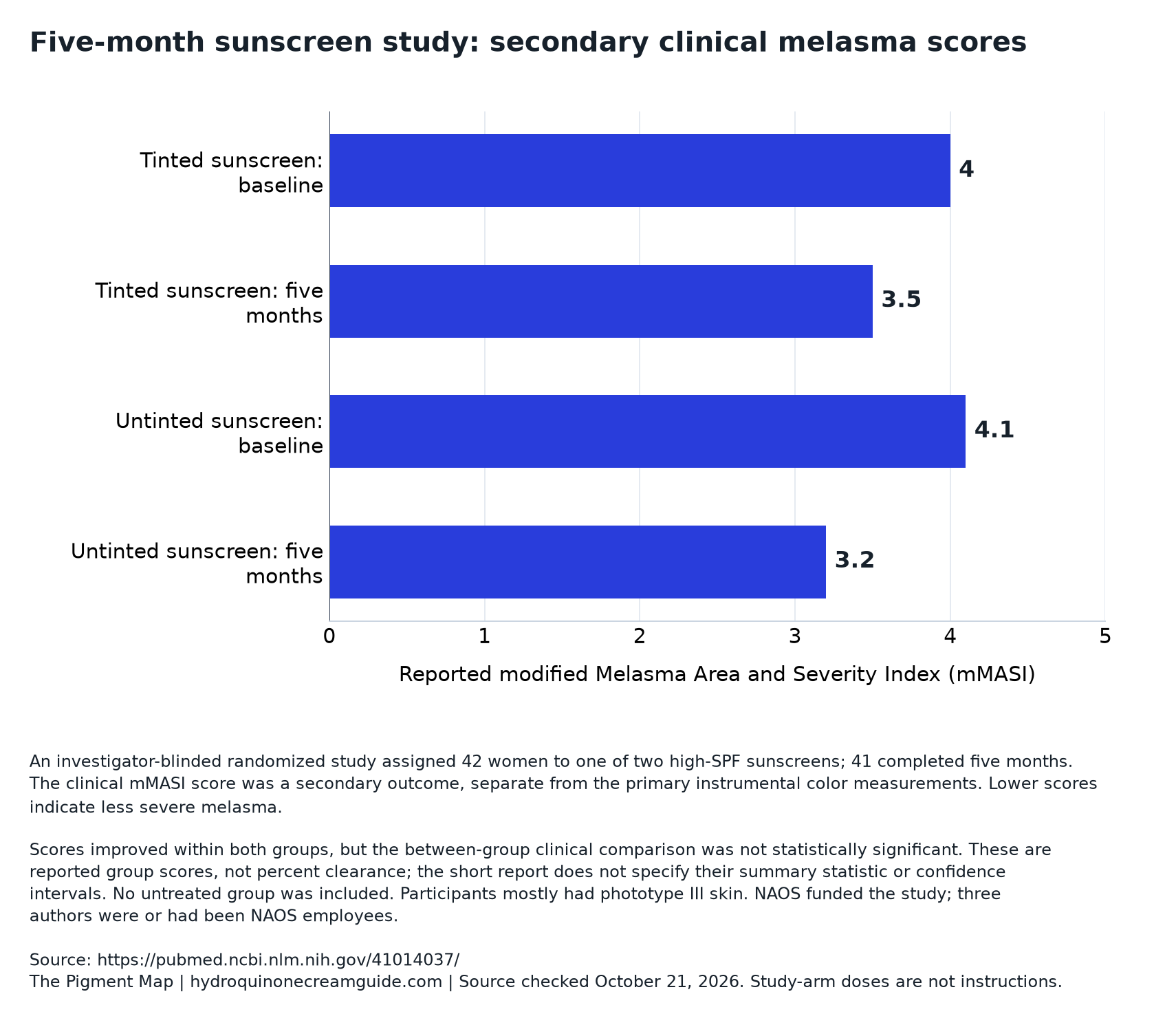
Both within-group P values were <0.001; the between-group clinical comparison was nonsignificant. The table preserves the reported values and their units. Its purpose is to make the observation inspectable, rather than to imply a more detailed analysis than the article reports or to assign the change to an individual formula component.
A clinical score and a proportion of responders require different information. The score describes a measurement under a defined system. A responder proportion needs an explicit threshold and a count of people crossing it. Converting a group-level score into the percentage of people helped would require individual observations that cannot be recovered from a pair of displayed values.
The distinction between within-group and comparative analysis is just as important. A change in one group asks a question about that group over time. A treatment effect requires an appropriate comparison against an alternative. Even a visually different trajectory does not remove the need to quantify that comparison and its uncertainty. Our interpretation retains the reported clinical assessment while declining to infer a component-specific effect, a universal advantage or a personalized probability from the table.
Modified Melasma Area and Severity Index (mMASI) group scores, a secondary outcome. The summary statistic is unspecified.
| Preparation | Baseline score | Five-month score |
|---|---|---|
| Tinted | 4.0 | 3.5 |
| Untinted | 4.1 | 3.2 |
An ingredient-specific experiment would need a targeted comparison
Starting measurements were imbalanced, and there was no untreated group. Those features constrain different conclusions. Starting positions affect interpretation of change; the absence of an untreated comparison limits conclusions about what would have occurred without either product. Neither can be repaired by choosing a more confident description of the result.
To study a component’s contribution, the intervention question must be narrower. The illustrative designs below show how adding, removing or isolating a component changes the inference available. They are proposed comparison structures, not additional arms of the sunscreen experiment. In each case, the background formulation and other relevant conditions would need to be specified well enough for the contrast to have a clear meaning.
An analysis would also need adequate precision for the difference it seeks to identify. A nonsignificant result is not a demonstration that two preparations are interchangeable. That stronger conclusion requires a suitable design and an acceptable difference defined in advance. Our reading of the short report does not reconstruct confidence intervals or numerical plot estimates. Its unexamined supplement is an evidence boundary, not an invitation to invent missing analysis details.
Illustrative design questions for ingredient attribution. These are methodological examples, not study results or actual treatment arms.
| Hypothetical comparison | Question addressed | Inference that remains separate |
|---|---|---|
| A plus B versus the same base | Effect of the complete combination in that context | How much each component contributes. |
| A plus B versus A in the same base | Effect of adding B while A is present | The effect of B used alone. |
| B versus the same base | Effect of B in that preparation | Its effect in every other combination. |
The prescription combination illustrates the same attribution problem
Tri-Luma contains hydroquinone 4%, tretinoin 0.05% and the corticosteroid fluocinolone acetonide 0.01%. Its US label trials compared the triple combination with dual-ingredient combinations and defined success as cleared. Those comparisons concern specified preparations and endpoints; they do not establish a universal effect for hydroquinone alone or every compounded product containing it.
A separate Chinese study used an eight-week primary criterion of a two- or three-grade decrease on the Melasma Severity Scale. Our analysis of that triple-combination trial examines its results in their own context. An improvement threshold and a clearance threshold are different definitions, so a percentage from one cannot silently become a percentage for the other.
The methodological lesson extends beyond the presence of several active ingredients. A component can be relevant to a preparation without its independent contribution being quantified by every experiment involving that preparation. An informative explanation should name the comparison that supports the proposed attribution. It should also distinguish an observed combination effect from a proposed reason for that effect. That allows ingredient-specific discussion to become more precise without claiming that the whole formula’s clinical record belongs to just one of its constituents.
The corticosteroid component must remain visible in safety interpretation
The Tri-Luma label warns about possible systemic corticosteroid effects, as well as irritation, hypersensitivity and hydroquinone-associated ochronosis, a blue-black discoloration. Its indication is short-term treatment of moderate-to-severe facial melasma, not maintenance. These are features of the labeled medicine’s record; they are not adverse-event findings from the sunscreen study.
A component-focused explanation should therefore consider potential harm as carefully as proposed benefit. Omitting a corticosteroid from the description while discussing the preparation as if it were a single-ingredient cream loses clinically relevant information. Conversely, identifying a possible risk does not establish that every user experiences it or supply a frequency absent from the evidence. Both the identity of the preparation and the type of supporting observation matter.
Our editorial interpretation of the irritation and allergy guide is to keep the observation and its clinical assessment connected. A person’s experience requires appropriate evaluation; a research summary should not diagnose its cause or prescribe a change. The scientific point is that treatment components, the studied exposure period and official precautions belong in the same explanation, so attention to one ingredient does not erase the rest of the formula’s safety context.
Tolerance reporting and commercial relationships answer different questions
Both sunscreens were described as well tolerated, without comparative adverse-event counts. Three authors disclosed current or former NAOS employment; Thierry Passeron disclosed industry honoraria. The funder is identified in the study facts above. These disclosures provide context for assessing the report, while the tolerance statement describes the kind of safety information presented. Neither supplies the missing details of the other.
The Chinese paper separately reports support from the Scientific Research Fund of Zhejiang Provincial Education Department and Zhejiang Fonow Medicine, with manufacturer-supplied products; its authors declared no conflicts. These relationships belong to that prescription experiment. Funding and supply should remain attached to the correct study rather than being blended into a general description of the evidence.
Our interpretation asks what would make each record more informative. For tolerance, that includes event definitions, counts, denominators and methods of collection. For commercial involvement, it includes transparency about design, analysis and access to data. A descriptive safety statement cannot establish zero risk, and a funding disclosure does not settle whether a particular inference is justified. Evaluating those questions separately produces a clearer account than treating either favorable tolerance or commercial support as a shortcut to a conclusion.
Connect a care question to the actual product record
FDA states that OTC hydroquinone skin-lightening products lack approval for safety and effectiveness and notes reports of rash, facial swelling and potentially permanent ochronosis. That notice is separate from the approved prescription Tri-Luma record. It does not establish the status of an unspecified compounded preparation or identify mercury contamination in an untested product.
Our editorial approach is to identify the exact record needed for the question. A clinical trial describes a studied intervention; a service review examines the available documentation for an offer. The Musely review and Dermatica review can help readers inspect those product and service terms. These links do not imply that either provider offers the tested sunscreen or reproduces the trial’s clinical outcomes.
The useful care question may be about the complete formula, the evidence for a proposed component role, the intended outcome or who evaluates a reaction. Naming that question helps prevent a product characteristic from standing in for a clinical result. The Pigment Map treats research as a way to clarify those connections, while leaving personal treatment decisions to an appropriate clinical discussion and preserving the distinction between documented terms and observed health outcomes.
Questions about the evidence
Does a plausible ingredient mechanism prove a clinical benefit?
A mechanism can motivate an experiment and help interpret a finding. It does not replace measurement of the relevant clinical outcome. Our methodological view is that the claim should identify whether the evidence concerns a proposed component role, a tested product characteristic or an observed effect of the complete preparation.
What would help identify the benefit of one component?
A targeted comparison would need to specify the component being changed and the background conditions held consistent. Studying an addition to a combination asks a different question from studying the component alone. The design should match the attribution being proposed, and the result should retain that context.
Can an optical measurement replace clinical assessment?
It provides a different kind of observation. Connecting an instrumental change to a meaningful clinical state requires evidence about that relationship. Our interpretation uses the measurements together where appropriate, without assuming that a smaller color difference establishes clearance or identifies the ingredient responsible.
Why retain every active ingredient when discussing a prescription cream?
The complete preparation is necessary for interpreting both benefit and safety evidence. A single ingredient’s familiar name can obscure other clinically relevant components. Our editorial approach preserves the formula and the comparison studied rather than describing a combination as if its entire record belonged to one ingredient.
What should remain explicit when evidence is transferred to another product?
The explanation should identify the new product, the properties assumed to match and the outcome expected to transfer. Each assumption needs support appropriate to the claim. A shared ingredient or product category alone does not establish that a different preparation, service or individual will reproduce a study result.
What this evidence supports
Ingredient-specific claims become more useful when the path of inference is visible. A proposed component role, a finished product’s measured property and a clinical outcome are related forms of evidence, but none automatically supplies the others. Our assessment is that the strongest explanation identifies what changed in the experiment, what remained comparable and what was measured. It then keeps benefits, safety precautions and commercial documentation attached to their correct records. That approach supports a focused care discussion without assigning an entire formula’s results to one ingredient or extending them to an untested product.
Research access and limitations
This reading uses the full sunscreen short report and funding footnote, the separate Chinese cream trial, official Tri-Luma labeling and FDA’s consumer notice. The sunscreen supplement and numerical plot values were not independently evaluated. Hypothetical component comparisons are methodological examples, not additional study results. No individualized regimen or provider outcome is inferred.