Start with the complete name
Obagi's current Clear page identifies hydroquinone USP 4%, or 40 mg per gram, as the active ingredient. It directs readers to their healthcare provider or its physician finder to purchase. That is a clinician-mediated route, not a public guarantee that any visitor can order a particular quantity at a fixed online price.
The manufacturer describes uses for several forms of discoloration. Those are its product claims. They do not diagnose a new mark, establish that every dark spot requires hydroquinone, or show that the reviewed cream outperforms another prescribed preparation. The assessment guide explains why the concern needs a name before the product does.
The Nu-Derm family also includes Blender and other steps. Sharing a brand family does not make those items interchangeable with Clear. A clinician may discuss a broader regimen, but this review does not turn the brand's system into instructions to purchase or combine every step.
Clear Fx is a separate comparison
The current Clear Fx page lists arbutin and antioxidants in a skin-brightening cream. Its displayed $125 price belongs to that cosmetic listing. We did not establish a current direct Clear Rx price from the manufacturer's prescription page, so the Rx price remains unknown here. A number from Fx would not close that gap.
The Fx list also contains lactic acid and carries an alpha hydroxy acid sunburn warning. The absence of a hydroquinone active does not mean that every alternative is free of irritation considerations. Nor does cosmetic positioning establish suitability during pregnancy or for someone with a particular allergy.
Customer ratings on the Fx page cannot answer whether prescription Clear produces a given response. Even when a reviewer mentions years of use, the exact product history, other treatments and diagnostic circumstances may be unclear. We did not use the site's AI-generated review summary as clinical evidence for either cream.
What the DailyMed record can establish
The linked DailyMed document identifies Clear as hydroquinone 4% and describes a 57 g bottle. Its insert says revised March 2018. That historical packaging record is useful for distinguishing Clear from neighboring products; it is not proof that the same quantity is currently stocked by a particular office or pharmacy.
The record also explicitly says the drug and labeling have not been approved by FDA. Listing in DailyMed does not reverse that statement. FDA's separate hydroquinone communication identifies Tri-Luma as the approved prescription combination discussed there; approval of that three-drug medicine does not transfer to Clear because both include hydroquinone.
Prescription status, an NDC and an FDA-approved application therefore belong in different fields. The prescription guide walks through those distinctions. We are describing the records, not making a new finding about the lawfulness or quality of a particular dispensed order.
The inactive lists do not fully match
The current Obagi webpage and historical DailyMed Clear list both name sodium metabisulfite, among other ingredients. But the lists are not identical: the current webpage includes phenyl trimethicone and PPG-2 myristyl ether propionate, for example, while the older Clear list differs. We cannot resolve that difference by silently merging the lists.
The practical next step is to request the complete ingredient information for the actual product supplied. A reader with a known reaction should share that history with the prescriber and pharmacist. An older label can identify a question to ask without guaranteeing the contents of a newly dispensed bottle.
Obagi's safety information highlights possible allergic reactions to sulfites, including potentially serious reactions in susceptible people. That warning does not mean every person with asthma or sensitive skin will react. It means that the base matters alongside the active percentage, especially when an allergy history is part of the decision.
Irritation requires a care plan
The public safety information discusses sensitivity and directs discontinuation when hypersensitivity occurs. A sensation of burning is not a reliable measure of pigment improvement. Blistering, marked swelling or a persistent rash should not be framed as a stage that must be endured to earn a result.
Our irritation and allergy guide explains what details help a clinician assess a reaction. Urgent symptoms such as trouble breathing or swelling affecting the mouth or throat require emergency attention, not a wait for routine product support.
The manufacturer also identifies pregnancy and nursing uncertainties. Its older pregnancy-category wording is not a substitute for current clinical counseling. The pregnancy and breastfeeding discussion separates those situations and explains why the complete formulation must be reviewed.
Get a quote that identifies the product
A useful written quote should name Clear Rx, the supplied quantity, dispensing route, consultation charge and shipping or collection arrangements. Ask whether any additional system products are optional, and what follow-up is included. An office visit fee and a product charge may be separate even when both arise from one appointment.
CoreAge's compounded Spot On offer currently lists hydroquinone 6% and kojic acid 6%; it names niacinamide without giving its percentage. The plan cards show $165 for three months (displayed as $54.99 monthly, although $165 divided by three is $55) or $70 for one month (displayed as $69.99). The Spot On review examines the same page's conflicting $42 claim. The dispensed quantity, complete base and niacinamide concentration still need confirmation. These offer details do not show that Spot On is preferable to Clear.
The comparison board now includes Obagi's route alongside the existing services. Clear adds a recognizable prescription name and a disclosed active strength, but the current invoice, exact supplied formula and clinical review arrangements still need confirmation. Those unanswered fields are part of this review's conclusion, not details to fill with a nearby product's marketing.
The separate Blender review follows another 4% prescription in this family. It distinguishes the currently linked 2010 insert, the later DailyMed record and the similarly named Blend Fx cosmetic without borrowing its price.
October check: the prescription route still needs its own quote
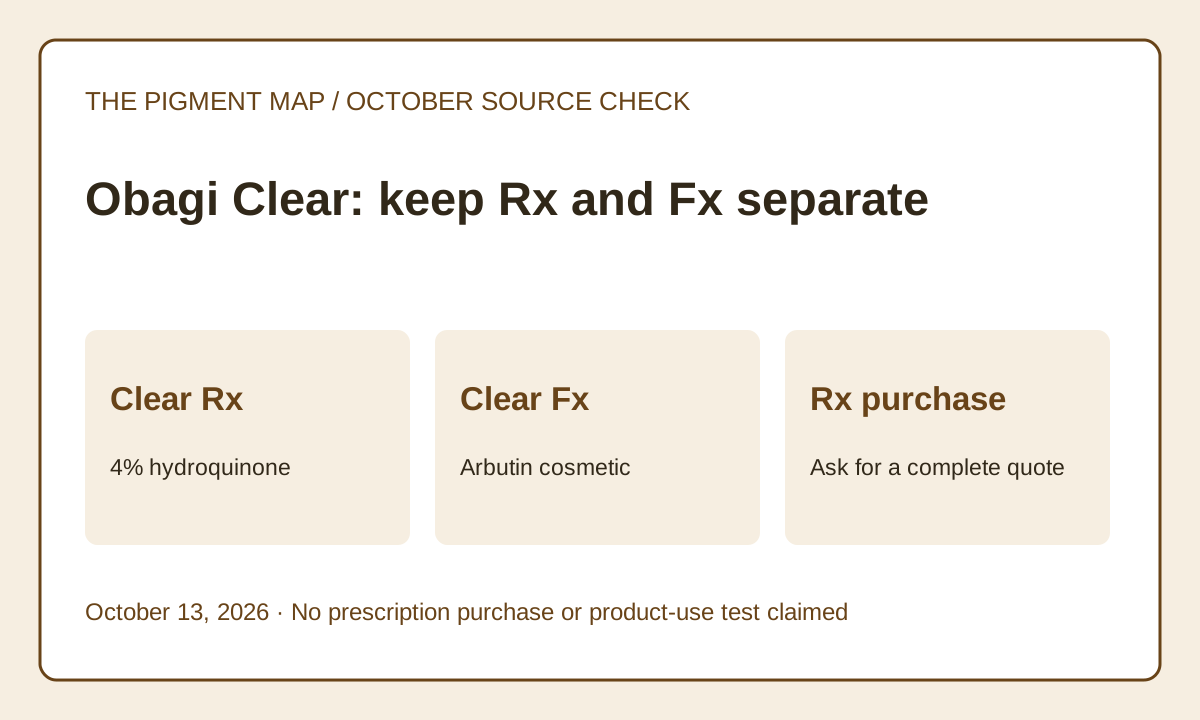
The October 13, 2026 manufacturer check continues to identify Nu-Derm Clear as prescription hydroquinone 4% and directs purchasers to a healthcare provider or physician finder. The current page supplies an active declaration and an inactive list, but no direct retail price or confirmed local stock. A recognizable product name therefore still needs a written quote for the actual quantity, consultation and dispensing arrangement.
The separately checked Clear Fx page displays $125 for an arbutin cosmetic. That price, its cart controls and its customer reviews remain attached to Fx. They do not establish the cost, availability or clinical results of prescription Clear. The comparison is useful precisely because the similar names can otherwise make a cosmetic purchase look like a prescription offer.
The current Rx page still lists sodium metabisulfite and retains allergy and pregnancy-related cautions. This update does not replace individual advice from the prescriber or pharmacist, and it does not redate the historical DailyMed label discussed above. Ask for the ingredient declaration supplied with the actual prescription, particularly if there is a prior reaction or a question about the differences between the current webpage and the older insert. We have not examined a newly dispensed bottle, verified a batch or tested the treatment.
Fresh official records: Nu-Derm Clear prescription page and Clear Fx cosmetic page, checked October 13, 2026.